

A few years ago, artificial intelligence felt like something only tech companies or scientists talked about. Now it quietly sits inside everyday tools, maps that predict traffic, apps that recommend what to watch, banking systems that detect fraud, and chat tools that write emails. Most people use AI every day without even realizing it. It makes life faster, easier, and more convenient, which is why it has become so normal so quickly.
But the more we rely on artificial intelligence, the more we also need to understand its downsides. The risks of artificial intelligence are not just about robots taking over the world. The real risks are already here: privacy issues, biased decisions, job automation, misinformation, and even changes in how people think and interact with technology. These risks are part of everyday life now, not just the future.
How Artificial Intelligence Is Already Part Of Everyday Life

Artificial intelligence is no longer limited to tech companies. It is used in shopping apps, banking systems, hiring platforms, customer service chatbots, navigation apps, streaming platforms, and even healthcare systems. Many decisions that affect people are now influenced by algorithms and machine learning systems.
For example, AI can:
- Recommend what you should watch or buy
- Filter resumes during hiring
- Detect fraud in banking
- Suggest routes in navigation apps
- Show personalized social media content
- Power virtual assistants and chatbots
This convenience is useful, but it also introduces several artificial intelligence risks that many people do not think about.
Privacy And Data Security Risks
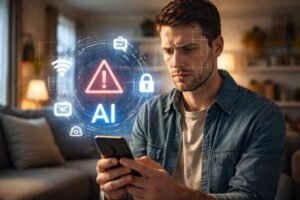
One of the biggest risks of artificial intelligence is data privacy. AI systems need huge amounts of data to work properly. This data often includes personal information such as search history, location, financial activity, messages, and online behavior.
Many people do not realize how much data they share with apps and AI tools. Free tools often collect user data to improve their algorithms. This creates several risks:
- Personal data can be stored for long periods
- Data can be sold to third parties
- Data breaches can expose private information
- AI tools can learn from sensitive user inputs
- Cybercriminals can use AI for advanced scams and phishing
AI-powered scams are becoming more dangerous because AI can now clone voices, generate realistic emails, and create fake identities that look very real.
Bias And Unfair Decisions In AI Systems

Many people assume machines are neutral, but AI is not automatically fair. AI systems learn from historical data, and if that data contains bias, the AI will repeat and sometimes amplify that bias.
This has already happened in areas like:
- Hiring systems
- Loan approvals
- Insurance pricing
- Facial recognition
- Medical diagnosis systems
This is known as algorithm bias, and it is one of the major problems with artificial intelligence. AI may unintentionally favor certain groups and disadvantage others because of biased training data.
Another issue is recommendation algorithms. Social media and content platforms often show people content similar to what they already like. Over time, this creates filter bubbles, where people only see information that matches their existing opinions, which can increase social division and misinformation.
Overreliance On AI And Loss Of Human Skills

Another risk that is not discussed enough is AI dependency. People are starting to rely on generative AI for writing, decision-making, problem-solving, navigation, and even communication.
Over time, this can lead to:
- Reduced critical thinking
- Lower creativity
- Poor decision-making skills
- Overdependence on technology
- Less ability to solve problems independently
If people rely too much on AI recommendations and automated decisions, they may stop questioning whether the AI is correct. But AI systems can make mistakes, generate wrong information, or misunderstand situations.
FAQs: Understanding The Risks Of Artificial Intelligence In Everyday Life
1. What are the biggest risks of artificial intelligence?
The biggest risks of artificial intelligence include data privacy issues, job automation, biased decision-making, misinformation, cybersecurity threats, and overreliance on AI systems.
2. Can artificial intelligence be dangerous in everyday life?
Yes, artificial intelligence can be dangerous in everyday life through privacy risks, AI scams, wrong automated decisions, deepfakes, and algorithm bias in hiring or financial systems.
3. How does artificial intelligence affect jobs?
Artificial intelligence automates repetitive and routine tasks, which can replace some jobs while creating new technical roles. The main issue is the skills gap between old and new jobs.
4. Why is AI bias a problem?
AI bias is a problem because AI systems learn from historical data. If that data contains bias, the AI may make unfair decisions in hiring, loans, insurance, and other important areas.
Final Thoughts
Artificial intelligence is not something coming in the future it is already part of everyday life. It helps people work faster, find information quickly, and automate many daily tasks. But like any powerful technology, it comes with trade-offs. Privacy concerns, biased algorithms, misinformation, job automation, and overdependence on technology are real risks that are already affecting society in small but noticeable ways. The biggest challenge is not stopping artificial intelligence but learning how to use it responsibly while understanding its limitations.
Artificial intelligence will continue to grow and become more powerful. The goal should not be fear, but awareness and responsible use. Technology should support human decisions, not replace human thinking.