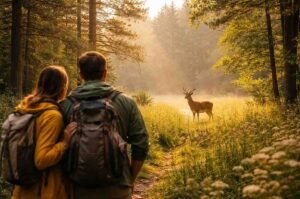


I didn’t expect silence to feel so loud the first time I stepped into a dense trail after weeks of constant screen exposure. No notifications. No traffic hum. Just wind moving through leaves and the slow rhythm of my own breathing. What struck me wasn’t relaxation; it was mental space. That experience helped me understand why the benefits of forest bathing for mental health go far beyond stress reduction.
Modern life keeps the brain in continuous directed attention, alerts, decisions, deadlines, and noise. Forest environments interrupt that cycle. They don’t demand focus; they hold attention gently. What feels like “just a walk in nature” is actually a deep neurological reset that affects how the mind processes emotion, memory, and sensory input long after you leave the trees.
What Forest Bathing Actually Changes In The Brain

Forest bathing, or shinrin-yoku, works through sensory immersion rather than physical exertion. The brain responds differently to natural stimuli than to urban stimuli. Leaves move unpredictably. Light filters softly. Sounds are layered but non-intrusive. This kind of input activates what psychologists call soft fascination, the effortless attention state that allows cognitive resources to replenish.
At the neurological level, time in forests increases activity in the Default Mode Network (DMN). This is the brain network associated with memory integration, creativity, and internal reflection. When the DMN engages in a balanced way, people experience clearer thinking, insight generation, and emotional processing. That’s why many people notice ideas surfacing or mental knots resolving during quiet time in nature without actively trying to think.
Cognitive Enhancement And Mental Clarity

One of the most overlooked benefits of forest bathing for mental health is cognitive restoration. Urban environments overload directed attention systems. Constant decision-making, notifications, and visual density fatigue the prefrontal cortex. Forest environments allow the system to rest while maintaining gentle engagement.
Research shows that immersion in natural settings restores attention capacity and reduces mental fatigue. People often describe this as “brain fog lifting.” Multi-day immersion studies even show substantial improvements in creative problem-solving performance, suggesting a deeper cognitive reset rather than temporary relaxation.
There’s also a creativity component. The DMN activation associated with forest exposure supports associative thinking and memory integration. That’s why writers, designers, and researchers often report idea breakthroughs after extended time outdoors. It’s not inspiration in a mystical sense; it’s restored cognitive bandwidth.
Emotional Regulation And Long-Term Resilience

Stress relief is immediate. Emotional resilience is cumulative. Repeated forest exposure appears to shift baseline mood regulation rather than just temporary state changes. People who regularly engage in nature immersion show lower levels of chronic rumination, anxiety, and depressive mood patterns.
This happens partly through neurotransmitter balance. Exposure to forest environments is associated with increased serotonin activity, which supports mood stability and emotional equilibrium. Over time, this can reduce emotional volatility and improve recovery from negative emotional states. Instead of emotions spiraling, they pass more fluidly.
Forest settings also reduce self-focused rumination. Natural environments broaden attentional scope to include outward sounds, textures, movement, and space. This outward orientation interrupts repetitive internal loops that sustain anxiety and depressive thinking. The mind shifts from self-analysis to sensory presence, which creates psychological distance from distress.
Sleep Architecture And Circadian Alignment

Sleep is one of the deeper benefits of forest bathing for mental health that rarely gets discussed. Natural light exposure, temperature variation, and reduced artificial stimulation help synchronize circadian rhythms, the body’s internal clock regulating sleep-wake cycles.
Forest immersion increases evening melatonin secretion and improves sleep efficiency. People fall asleep faster, experience fewer nighttime awakenings, and report deeper rest. This matters because sleep architecture directly affects emotional regulation, memory consolidation, and mood stability. Poor sleep amplifies anxiety and depressive symptoms; improved sleep buffers them.
The mechanism is both biological and sensory. Daytime natural light strengthens circadian signaling. Physical movement outdoors increases sleep pressure. Nervous system down-regulation reduces hyperarousal at night. Together, these create conditions for restorative sleep rather than fragmented rest.
Support For Mental Health Conditions

Forest therapy is increasingly explored as a complementary approach for clinical mental health challenges. While not a standalone treatment, evidence suggests meaningful supportive effects across several conditions.
- Attention difficulties: Time in natural environments improves sustained attention and reduces symptoms associated with attention regulation challenges.
- Burnout and emotional exhaustion: Nature immersion lowers psychological fatigue and improves mood recovery in high-stress professionals.
- Trauma recovery: Preliminary findings indicate reduced hyperarousal and improved emotional grounding with guided forest exposure.
- Anxiety and depressive symptoms: Regular nature contact correlates with lower severity scores and improved emotional balance.
These effects likely arise from combined cognitive restoration, nervous system regulation, and sensory grounding rather than any single mechanism. Forest environments provide both stimulation and safety complexity without threat, which is ideal for psychological recalibration.
Why Forest Experiences Feel Psychologically Different
Urban environments compress perception, with straight lines, constant noise, and predictable surfaces. Forests expand perception depth, texture, irregularity, and layered sound. This perceptual expansion changes mental processing. Attention widens. Time perception slows. Internal dialogue quiets.
There’s also a scale effect. Trees, open sky, and natural horizons alter self-perception relative to the environment. People often report that perspective shift problems feel smaller, and identity feels less constrained. This isn’t philosophical abstraction; it’s spatial cognition interacting with self-referential processing. The mind recalibrates in larger spaces.
That’s why nature-based wellness activities often produce emotional clarity rather than just calm. When cognitive load drops and perception expands, underlying thoughts surface in a less reactive state. People process rather than suppress.
Integrating Forest Exposure Into Modern Life

You don’t need remote wilderness to access the mental health benefits of forest bathing. Even moderate green spaces with dense vegetation, tree canopy, and natural sound patterns can produce measurable psychological effects. The key is sensory immersion rather than physical distance.
A simple practice structure:
- Move slowly without performance goals
- Engage multiple senses: sound, texture, light
- Pause frequently rather than walking continuously
- Reduce device interaction
- Allow attention to drift naturally
Duration matters less than quality. Even short, consistent exposures appear to accumulate benefits across mood regulation, cognition, and sleep patterns.
FAQs: Understanding The Benefits Of Forest Bathing For Mental Health Beyond Stress Relief
1. How often should you practice forest bathing for mental health benefits?
Research suggests benefits accumulate with regular exposure. Even 1–2 sessions per week in natural settings can improve mood regulation, attention, and sleep patterns over time.
2. Can forest bathing help with anxiety and depression symptoms?
Yes. Studies show reduced rumination, improved mood stability, and lower self-reported anxiety and depression scores with consistent nature immersion practices.
3. Does forest bathing require deep wilderness environments?
No. Dense parks, wooded trails, and tree-rich green spaces can provide similar cognitive and emotional benefits if they allow sensory immersion and reduced urban stimulation.
4. How long does it take to feel mental health effects?
Immediate relaxation often occurs within minutes, but stronger effects like improved sleep, attention restoration, and emotional resilience typically build with repeated exposure over weeks.
Final Thoughts
Forest bathing changes mental health through layered mechanisms: cognitive restoration, nervous system regulation, emotional recalibration, and circadian alignment. What begins as quiet exposure to trees becomes a restructuring of attention and mood patterns. In environments that constantly demand focus and speed, forests offer the opposite: effortless attention and psychological spaciousness. That contrast allows the mind to recover functions that modern life steadily erodes.
Spending time among trees isn’t an escape. It’s neurological maintenance.