
Artificial intelligence sounds complicated until you understand how it actually learns. Most people think AI is just programmed to do things, but that is not how modern AI works. AI systems learn from data the way humans learn from experience. The more data they see, the better they become at recognizing patterns and making decisions.
I remember the first time I tried to understand machine learning workflows, and it felt overly technical. But once you break the AI learning process into stages, it becomes much easier to understand. It is basically a cycle where data is collected, models are trained, predictions are made, and the system keeps improving over time.
Understanding How AI Learns From Data

The AI learning process starts with data. Without data, AI cannot learn anything. Data is the experience from which AI systems identify patterns, relationships, and trends. This data can come from many sources, like customer transactions, images, text documents, sensors, or user behavior.
Before AI can learn, the data must be prepared properly. Raw data is usually messy, incomplete, or inconsistent, so it needs to be cleaned and organized. This stage is very important because the quality of data directly affects the accuracy of AI predictions.
In most machine learning workflows, this stage includes:
- Data collection
- Data cleaning
- Data labeling
- Data formatting
- Feature selection
Feature selection means choosing the most important variables that help predict the outcome. For example, if AI is predicting house prices, important features could be location, size, number of rooms, and age of the property.
The AI Training Process: How Models Actually Learn

Once the data is ready, the next step is AI model training. This is where the actual learning happens. During training, the AI system tries to find patterns in the data and connect inputs to outputs.
The training process usually follows a loop:
- The model makes a prediction
- The system checks how wrong the prediction was
- The model adjusts itself
- The model tries again
- This repeats thousands or millions of times
This process is called the learning loop. Over time, the model becomes more accurate because it keeps correcting its mistakes. This is why people say AI learns from errors.
Many AI systems use neural networks, which are mathematical models inspired by the human brain. These networks adjust internal parameters called weights to improve prediction accuracy. The system keeps optimizing until the error becomes very small.
Model Validation and Evaluation

After training, the AI model cannot be used immediately in real-world situations. It must be tested first to make sure it works correctly and does not just memorize the training data.
This stage includes validation and evaluation. The model is tested on new data that it has never seen before. This helps check whether the model can make accurate predictions on real-world data.
Experts usually evaluate AI models using metrics like:
- Accuracy
- Precision
- Recall
- Error rate
- Model performance score
If the model performs poorly, engineers adjust the model, improve the data, or retrain the system again. This shows that the artificial intelligence learning process is not a one-time process. It is iterative and continuous.
From Predictions to Decisions
Once the model is trained and tested, it is deployed into real systems where it starts making decisions. This stage is often called inference. Inference means using the trained model to analyze new data and produce predictions or decisions.
For example, AI systems today are used for:
- Fraud detection in banking
- Movie and product recommendations
- Voice assistants
- Traffic prediction
- Medical image analysis
- Customer service chatbots
In these systems, AI analyzes new incoming data and decides the most likely outcome based on patterns it learned during training. This is how data turns into decisions.
The Continuous Learning Feedback Loop

One of the most important parts of the machine learning process is the feedback loop. AI systems do not stop learning after deployment. Many systems continue collecting new data and retrain themselves to improve accuracy over time.
This creates a cycle:
Data → Training → Prediction → Feedback → Improvement → Retraining
This continuous loop is why AI systems keep improving and becoming more accurate over time. For example, recommendation systems become better the more you use them because they learn your preferences.
Types of AI Learning Methods
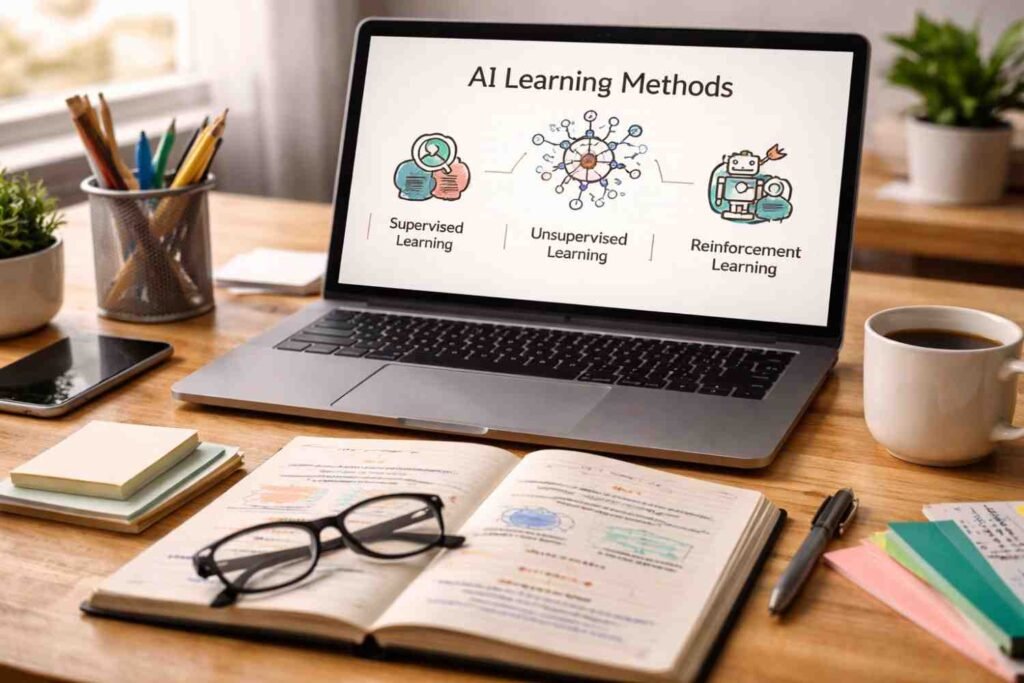
Problems with artificial intelligence are that AI systems do not all learn in the same way. There are three main types of learning methods used in machine learning.
Supervised Learning
In supervised learning, the AI is trained using labeled data. This means the correct answer is already known, and the model learns by comparing its predictions with the correct answers. This method is commonly used for spam detection, price prediction, and image classification.
Unsupervised Learning
In unsupervised learning, the AI works with unlabeled data and tries to find patterns on its own. It groups data based on similarities and patterns. This method is often used for customer segmentation, pattern detection, and recommendation systems.
Reinforcement Learning
Reinforcement learning works through trial and error. The AI system receives rewards for correct decisions and penalties for wrong decisions. Over time, it learns the best strategy to maximize rewards. This method is used in robotics, game AI, and autonomous systems.
FAQs: AI Learning Process Explained: From Data to Decisions
1. What is the AI learning process in simple terms?
The AI learning process is how machines learn from data, find patterns, train models, test accuracy, and then use that knowledge to make predictions or decisions on new data.
2. How does AI learn from data?
AI learns from data by analyzing patterns and relationships in training data, making predictions, measuring errors, and adjusting itself repeatedly to improve accuracy.
3. What is AI model training?
AI model training is the process by which algorithms learn patterns from data by repeatedly making predictions, checking errors, and improving the model to increase accuracy.
4. Why does AI need so much data to learn?
AI needs large amounts of data because more data helps the model identify patterns more accurately, reduce errors, and make better predictions in real-world situations.
Final Thoughts
The AI learning process is not a single step but a continuous cycle that starts with data and ends with decisions, then loops back again for improvement. Once you understand the flow from data collection to training, validation, deployment, and feedback, AI becomes much easier to understand. It is basically a system that learns from experience, just like humans do, but at a much larger scale and speed.
As AI continues to evolve, understanding how it learns will become more important for everyone, not just engineers or data scientists.