

A few years ago, most people interacted with artificial intelligence without even realizing it. Recommendation systems, navigation apps, and voice assistants were already part of daily life. But things started to feel different when AI began writing emails, generating images, creating code, and even helping with research. That shift is where generative AI entered everyday conversations, not just tech circles.
Understanding the generative AI meaning is important now because this technology is not limited to engineers or data scientists anymore. Students, marketers, designers, developers, and business owners are already using generative AI tools in their daily work. The technology is quietly changing how people create, work, and make decisions.
Generative AI Meaning in Simple Words

Generative AI refers to artificial intelligence that can create new content instead of just analyzing existing data. Traditional artificial intelligence focuses on recognizing patterns, making predictions, or classifying information. Generative AI, on the other hand, produces something new, like text, images, music, videos, or even software code.
In simple terms, if regular AI tells you what something is, generative AI creates something that did not exist before.
For example:
- Writing articles or emails
- Generating images from text prompts
- Creating marketing copy
- Writing computer code
- Generating product designs
- Creating synthetic data for research
This is why generative AI technology is considered a major shift in how people interact with machines.
How Generative AI Works

To understand generative AI more clearly, it helps to know how generative AI works at a basic level. These systems are trained on massive datasets that include text, images, audio, or code. They learn patterns, language structures, design styles, and relationships between data.
Most modern generative AI tools use:
- Machine learning models
- Large language models
- Neural networks
- Deep learning algorithms
When a user gives a prompt, the AI predicts and generates the most relevant output based on patterns it learned during training. That is why AI content generation often feels human-like.
Generative AI vs Artificial Intelligence
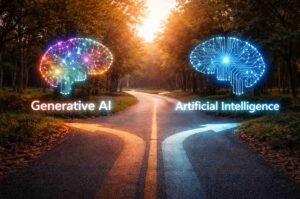
Many people confuse artificial intelligence with generative AI, but they are not exactly the same thing.
Artificial intelligence is a broad field that includes:
- Recommendation systems
- Fraud detection
- Voice recognition
- Predictive analytics
- Automation systems
Generative AI is a subset of artificial intelligence that focuses specifically on content creation and generation.
So the difference is simple:
- Artificial Intelligence → Analyzes, predicts, classifies
- Generative AI → Creates new content
This distinction is important when discussing generative AI applications and future technology trends.
Why Generative AI Matters More Than People Think

At first, many people saw generative AI as a tool for writing content or creating images for fun. But the impact is much bigger. Generative AI is changing how knowledge work happens, not just manual work.
One major shift is that people can now interact with complex machine learning systems using plain English instead of programming languages. This makes advanced technology accessible to more people, not just engineers.
Generative AI is also expected to have a massive economic impact by improving productivity, automating tasks, and creating new business models. Many industries are already using AI for automation, forecasting, product design, and customer experience.
Another important change is the automation of knowledge work. Previous automation mainly affected manufacturing and repetitive tasks. Generative AI can now automate tasks like:
- Writing reports
- Drafting legal documents
- Creating marketing campaigns
- Financial analysis
- Research summaries
- Software development support
This changes how many professional jobs will evolve in the future.
Industries Where Generative AI Is Making a Big Impact

Generative AI applications are growing across industries. Some areas are seeing faster adoption than others.
Healthcare
Generative AI is used to create synthetic patient data for research while protecting privacy. It is also helping researchers generate new molecular structures and protein sequences, which can speed up drug discovery and medical research.
Manufacturing
Generative design tools can create thousands of product design variations optimized for cost, materials, and performance. Engineers can choose the best design instead of creating everything manually.
Finance
Financial institutions use generative AI to simulate transaction scenarios, detect fraud patterns, and generate financial reports and forecasts.
Retail and E-commerce
Retail companies use AI for virtual try-on experiences, personalized recommendations, and inventory forecasting based on trends and customer behavior.
These examples show that generative AI is not just a tech trend but a major shift in how industries operate.
The Future of Generative AI

The future of generative AI will likely focus on automation, personalization, and productivity tools. Instead of replacing entire jobs, generative AI will more likely change how people work by automating repetitive and time-consuming tasks.
People who learn how to use AI tools effectively will likely work faster, create more content, and make better decisions using AI assistance. Generative AI will probably become a normal part of daily work, similar to spreadsheets, email, or search engines.
Understanding generative AI’s meaning today is similar to understanding the internet in the early days. The people who understood it early were better prepared for how technology changed everything later.
FAQs: Generative AI Meaning and Why It Matters More Than You Think
1. What is the simple meaning of generative AI?
Generative AI means artificial intelligence that can create new content, such as text, images, audio, video, or code, instead of just analyzing data.
2. What are some examples of generative AI?
Examples include AI writing tools, image generators, coding assistants, chatbots, product design tools, and AI content creation software.
3. How is generative AI different from artificial intelligence?
Artificial intelligence analyzes and predicts data, while generative AI creates new content based on patterns learned from large datasets.
4. Why is generative AI important?
Generative AI is important because it automates knowledge work, improves productivity, enables personalization, and is changing how many industries operate.
Final Thoughts
Generative AI is not just another technology trend. It represents a shift in how humans interact with machines and how work gets done. Instead of only analyzing information, machines can now create, design, write, and generate ideas. That changes productivity, creativity, and decision-making across almost every industry. People who understand how generative AI works and how to use it effectively will have a significant advantage in the coming years.
The technology is still evolving, but its impact is already visible. Learning and adapting to generative AI now will be more important than many people realize.